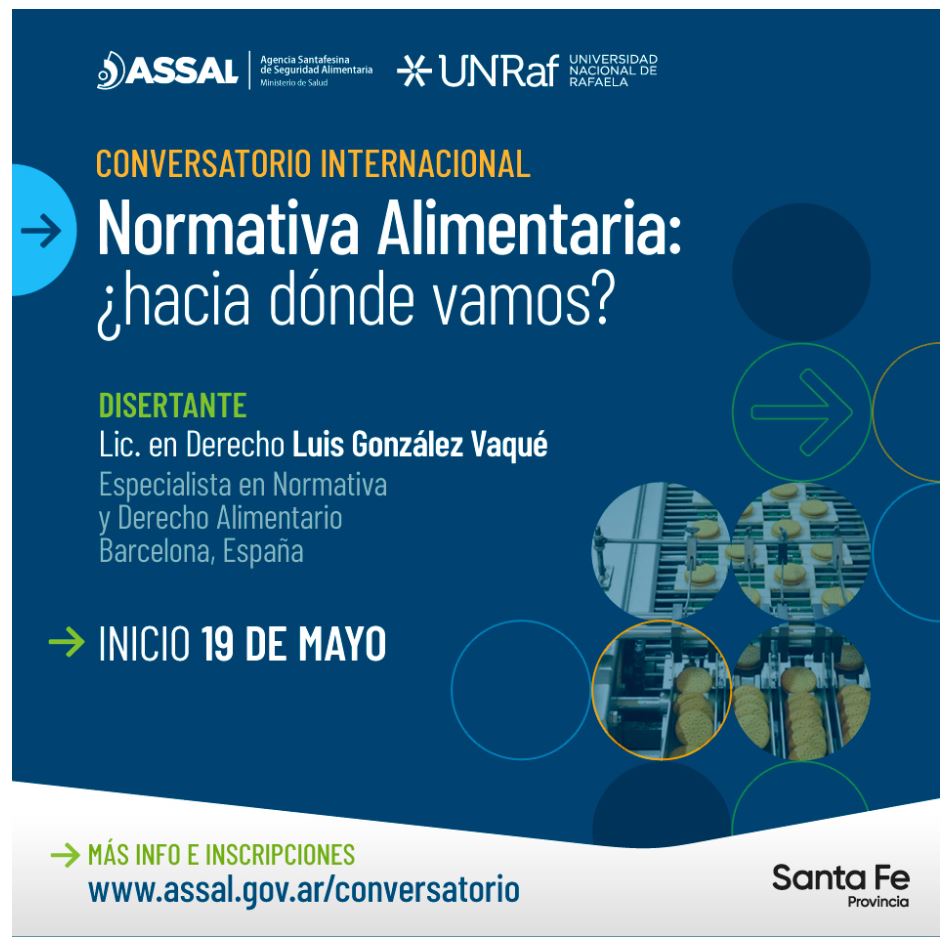
Invitación al tercer encuentro del Conversatorio internacional junto #UNRaf, gratuito y únicamente a distancia: 16 de junio de 2021 - 15:00 h. Argentina;
20:00 h. España.


“Food security exists when all people have physical, social and economic access to sufficient, safe and nutritious food that meets their daily energy needs and food preferences for an active and healthy life” World Food Summit 1996.
The World Food Safety Day (WFSD) is celebrated on June 7, with the primary objective of inspiring actions to help prevent and detect possible risks that are transmitted through food, to achieve food security worldwide, but at the same time contribute to improving human health, economic growth of peoples, increase agriculture, livestock, and tourism, as well as achieving sustainable development of nations.
Globally, it is estimated that about 420 thousand people die annually, affecting mostly children under 5 years of age, with 125 thousand deaths. [1]
Due to the Covid 19 pandemic, we have all been forced to take extreme measures for cleanliness, health, and personal care, including the strengthening of good hygiene practices for food or containers.
Food safety has also become increasingly important in recent years in response to the various outbreaks of food poisoning. As a result, legislation has become increasingly strict in this respect, delegating all responsibility to the owner of the product or establishment and requiring the implementation of a self-monitoring system by product manufacturers, as well as requiring analytical controls to ensure that food products comply with the microbiological criteria established in the legislation in force in the various territories.
For this reason, most countries currently establish different regulations to control the quality and safety of food at the different stages of the production and marketing chain, regulations that apply to both domestic and foreign companies that act as importers, producers, distributors, retailers, and handlers of food of various kinds, establishing the obligation to comply with analysis to verify the quality of food as a necessary requirement for the process of sanitary registration of products, and in due course for their marketing.
At the Central American level, there is RTCA 67.04.50:17 Food. Microbiological Criteria for Food Safety, which is the applicable food standard.
The quality of a product is verified through food analysis since this will determine whether the product is inadequate conditions for consumption or whether the product is deficient or lacks any health requirements that must be met.
We have the purpose of taking home a good quality food, this implies that we have to know what analysis should be performed on food and one of them is the first thing we should know: The chemical composition by quantification of the majority and minority components, this means that analyses of proteins, carbohydrates, fat, total minerals, vitamins, and minerals will be performed.
From the food point of view the established in the overall composition of a food is a mandatory preliminary step that is to obtain data that measure the nutritional effectiveness of various components and should have several techniques in food, one of them is the freshness of the food, physicochemical methods, thereby providing results with nutritional significance, and microbiological. These techniques detect the possible biochemical or enzymatic degraders in a portion of food, so we can realize that if a food has been degraded biochemically presenting oxidation in fats. Analyses in food are performed to determine foreign or natural substances that pose a danger to the consumer. [2]
Generally, this type of control is in charge of the Ministry of Health of each country, or of their Food Regulation and Control Departments and in other cases of Private Laboratories who are in charge of the work of food analysis.
This is because although food contains microorganisms that are beneficial for the manufacturing process of food and beverages, as well as for other types of products such as medicines, vaccines, or vitamins, and that are indispensable in our ecosystem and human welfare, there may also be pathogenic microorganisms, for example, Salmonella, E.coli, toxins, or other microorganisms, which if not detected promptly could endanger the health of the consumer, as they can cause infections or serious poisoning.
Thus, with the analyses carried out for the Food Sanitary Registration, there is the possibility of detecting the presence of toxic or undesirable substances that can be found in food, and that can cause damage to the health of consumers on time.
The components of food, whether water, amino acids, oils, fats, vitamins, among others, have specific properties that can be altered after changing handling and processing or natural issues, which is why carrying out analyses before authorizing the marketing of products is a relevant aspect for potential consumers.
Being able to analyze and check if the quality of food is modified or if it is contaminated is essential to distinguish whether it has become a product that poses a risk to the health of consumers or if it maintains its nutritional properties intact. [3]
It is for this reason that analysis is fundamental and indispensable to ensure food safety in the processes of storage, processing, transport, and distribution to the final consumer.

It is important to be aware of what food safety means, so knowing the quality and condition of the food we consume is essential to be certain that what we are eating meets the requirements and quality standards.
Nowadays we can know the origin, nutritional composition, and traceability of each food that reaches our table, thanks to the involvement of all the agents of the sector that help to control the products and raw materials throughout the food chain.
Finally, it is important to mention that international food trade is regulated by the World Trade Organization (WTO), ensuring that all food trade is controlled by standards, guidelines, and recommendations of the Codex Alimentarius Commission, the World Organization for Animal Health (OIE) and the International Plant Protection Convention (IPPC or IPPC). Standards, guidelines, and other recommendations have become the basis for safe food production and consumer protection in the international food trade. [4]

[1] https://www.paho.org/es/campa%C3%B1as/dia-mundial-inocuidad-alimentos-2020
[2] http://musoqwaira.blogspot.com/2009/04/importancia-de-los-analisis-de-loss.html
[3] https://www.fichatec.com/blog/analisis-quimico-de-los-alimentos/
[4] https://www3.paho.org/hq/index.php?option=com_content&view=article&id=10834:2015-justificacion-e-importancia-del-sistema-haccp&Itemid=41432&lang=es



Land acquisition and use
With the exception of certain specific regulations regarding foreign ownership of rural land, transactions related to land located in areas of national security that are nominated by law as ‘frontier zones’, and local regulations that impose certain requirements that must be addressed by the parties to a certain transaction (eg, surveys), property transactions are generally conducted under a similar legal structure as other kinds of real estate transactions, all of which are regulated by the Civil and Commercial Code (CCC).
After a preliminary negotiation with the seller through selling and purchasing agents (realtors and brokers), the transaction generally starts with the execution of a document called a ‘reserve’, signed and delivered by the purchaser and received by the realtor, by which the buyer offers a certain price and conditions for the acquisition of the land and deposits cash or a cheque with the broker as a guarantee of his or her offer. If the seller accepts the offer, sometimes the parties sign a preliminary sale agreement, a similar document by which the parties agree in detail with all the commercial conditions of the transaction, and the purchaser pays 10 per cent to 30 per cent of the price.
In other cases, the parties agree on signing the purchase deed directly without executing a preliminary sale agreement after a term that usually lasts between 30 and 90 days from the date of the acceptance of the reserve by the seller. If the seller accepts the reserve or executes the preliminary sale agreement, any ‘down payment’ is considered as confirmation of the transaction; however, it is customary to include a clause by which both the buyer and the seller can desist from concluding the transaction. If the buyer desists, the seller is entitled to keep the down payment as a penalty to the buyer. If the seller does not continue with the transaction, then the seller must reimburse the amount of the down payment and an equal amount as a penalty in favour of the buyer.
When the property is owned by a legal entity, the transaction is usually structured through a stock purchase agreement, for tax reasons.
The CCC provides for two requirements upon the acquisition of ownership: the transfer of possession and the title that is the public deed by which the seller transfers ownership to the buyer, which is formalised by a notary public. Then the deed is registered before the property registry of the province in which the land is located.
According to official studies, farmland is typically held by the owners. However, farmers have been increasingly cultivating land under a rural tenancy system. It is common to structure the agricultural production through annual contracts. In addition, farmland is also held, in a smaller proportion, by undivided estates.
Restrictions related to measurements, surveys, fences and rural roads are regulated by each province under their rural codes. For instance, in Buenos Aires, apart from the Rural Code, there are other restrictions imposed by Decree-Law No. 8912/1977 on the use of soil and by Decree-Law No. 3202/2006 on environmental issues, as well as by the Water Law.
Apart from local restrictions, others established in the CCC relate to:
There is also a regulation in the CCC on the surface right by which an owner grants to a third party the right of planting, foresting or constructing a building on the owner’s land. The maximum period authorised by law for construction is 70 years, and for planting or foresting, it is 50 years.
Non-agricultural land rules
The CCC contains general rules related to hunting activities, although the activity is protected under National Law No. 22,421, regulated by the Decree-Law No. 666/1997, to which provinces can adhere. In provinces that do not adhere to Law No. 22.421, such as Buenos Aires, hunting is regulated by the Rural Code, including regulations on hunting preservation, breeding sites for wild animals and zoos.
Besides those non-agricultural uses, rural land may be used for the establishment of national parks, natural monuments and national reserves, as it is regulated by Law No. 22,351. For these uses, a previous assignment or donation of the land shall be made by a private entity or a province, also considering assignment of jurisdiction, which generally requires a provincial law.
In addition, the provinces have the option of regulating the systems of protected rural areas, access to which can be made by donation from a private entity or via expropriation.
Lending
There are no special norms that regulate loans secured with farmland, so general regulations on loans and guarantees established in the national and general legislation apply.
Nevertheless, the limitations for the acquisition of rural land by foreigners settled under Law No. 26,737 and Decree-Law No. 274/2012, modified by Decree-Law No. 820/2016, must be considered for the acquisition of rural properties by any foreigner as a result of an enforcement or in the context of an insolvency or bankruptcy proceeding.
Provinces might pass agricultural emergency laws under which a temporary stay could be granted – between 90 to 180 days – against judicial or extrajudicial auctions based on debts with public bank entities, and occasionally provinces have issued rules that limit any judicial or extrajudicial auction over real estate or prevent the seizure of agricultural machines that have been offered as collateral security of banks or private loans.
Publicly controlled property
The CCC allows local public authorities to regulate a minimum size for real estate, when its division into smaller sizes means that it is no longer economical.
In case of a condominium, there are regulations in the CCC that entitle any owner of property to request judicial protection to avoid a division of the condominium when the division could be potentially harmful for the owners or for the main use of the property.
Some provinces have enacted regulations that define the concept of economic units (eg, La Pampa and Buenos Aires provinces) and have also established, in some cases, restrictions on the division of a property when its surface unit is lower than the minimum surface unit that is required in those jurisdictions for a rural piece of land to qualify as an economic unit.
Foreign ownership restrictions
Law No. 26,737 (enacted in 2012) imposes restrictions on the acquisition of rural land (farm property) by foreign individuals and foreign entities. This Law was first complemented by Regulatory Decree No. 274/2014 and subsequently by Regulatory Decree No. 820/2016.
Any acquisition, conveyance or assignment of possession rights of rural lands in favour of any foreign individual or foreign entity requires previous authorisation by the Argentine National Registry of Rural Land, irrespective of the purpose, use or location of the rural land. Dispositions 7/2019 and 8/2019 implemented forms to be completed and submitted online to speed up the process of prior authorisation.
For the purpose of this Law, a foreign individual is defined as a person from a foreign country who does not have Argentine citizenship. Some exceptions apply to foreign individuals who at the time of acquisition have:
A foreign entity is defined as an entity that has been formed under Argentine or international regulations with at least 51 per cent of equity held by foreign individuals, foreign entities, government agencies, constructive association or partnerships, or an entity that allows foreign members (with the appropriate percentage of votes) the right to adopt resolutions of the entity.
The most significant prohibitions under Law No. 26,737 are that:
Finally, any act intended to conceal property vicariously held by a foreign entity or foreign individual under the appearance of being held by an Argentine entity or individual, as well as any act in violation of this Law, is considered fraudulent and is declared by the Law as null and void.
Gonzalo Ballester and John O'Farrell [JP O'Farrell Abogados]


⚠️ Inscripción abierta al segundo encuentro del Conversatorio internacional junto #UNRaf, gratuito y únicamente a distancia: 2 de junio de 2021 - 15:00 h. Argentina; 20:00 h. España.