sexta-feira, abril 17, 2020

15º BATE-PAPO VIRTUAL – DIREITO AMBIENTAL EM TEMPOS DE COVID-19

Em momentos de incerteza é importante saber a opinião de especialistas!

Participe do 15º Bate-papo Virtual, que abordará o tema “ Direito Ambiental em tempos de COVID-19”, assunto de grande interesse na atualidade. Muito relevante entendermos como agir e reagir nesse momento. 

O evento (que é gratuito e totalmente on-line) terá como expositores renomados e experientes profissionais com grande atuação na área.


Expositores:


- Margareth Bilhalva: Consultora e Advogada Master da Petrobras e Vice-Presidente da UBAA (União Brasileira da Advocacia Ambiental);

- Maurício Couto: Engenheiro e presidente da CECA (Comissão Estadual de Controle Ambiental do Rio de Janeiro);

- Flávia Marchezini: Advogada e Professora de Direito Ambiental;

- João Emmanuel Cordeiro Lima: Advogado e Professor de Direito Ambiental;

- Gláucia Savin: Advogada e Presidente da Comissão de Meio Ambiente da OAB/SP.


Quando: dia 21 de abril de 2020 (terça-feira)

Horário: das 18:00 às 19:30h.

Sistemática: exposições e debates


Coordenação:

Marcos Saes e Albenir Querubini


*Inscrições gratuitas, com acesso pelo link: https://zoom.us/j/98267638570 


O evento também será gravado e posteriormente disponibilizado no YouTube (Canal Direto Ambiental) e os apontamentos no Portal DireitoAmbiental.com (www.direitoambiental. com)

Compartilhar conhecimento é obrigação de todos!

quinta-feira, abril 16, 2020

Revista de Derecho del Consumidor (Instituto Argentino de Derecho del Consumidor)


Número 8 - Abril 2020:

https://ar.ijeditores.com/pop.php?option=publicacion&idpublicacion=166&idedicion=3398 DOCTRINA 🔴 La tutela del consumidor en tiempos de pandemia - Arias, María Paula 🔴 Análisis sobre la relación de consumo existente entre el trabajador y su aseguradora de riesgos de trabajo - Cosentino, Patricio M. 🔴 La perspectiva de género en el Derecho del Consumidor - Frustagli, Sandra A. 🔴 Las relaciones de consumo después de la pandemia. Herramientas del CCyCN que aportan soluciones al problema - Krieger, Walter F. 🔴 El corrimiento del velo societario frente a daños causados a consumidores y violaciones a la Ley de Defensa del Consumidor - Moro, Emilio F. 🔴 Breves nociones del mal llamado daño punitivo - Pandiella Molina, Juan C. JURISPRUDENCIA COMENTADA 🔴 Transporte aéreo, comercio electrónico y la protección del consumidor turista electrónico. Comentario al fallo "Despegar.ar SA c/GCBA s/Recurso Directo sobre Resoluciones de Defensa al Consumidor" - Mendieta, Ezequiel N. [...]


Presidente: gonzalu70@outlook.es


terça-feira, abril 14, 2020

INFORMATIVO DE INTERESSE EM MATÉRIA AGRÁRIA E AMBIENTAL - 14 de abril de 2020 – n. 012/2020

INFORMATIVO DE INTERESSE EM MATÉRIA AGRÁRIA E AMBIENTAL 

- 14 de abril de 2020 – n. 012/2020


ESPECIAL “LEI DO AGRO” - O Presidente Jair Bolsonaro sancionou, com vetos, a chamada MP do Agro (Medida Provisória nº 897/2019), que passou a ser a Lei nº 13.986, de 7 de abril de 2020, a qual foi pensada para modernizar o sistema financiamento privado do agronegócio e garantias prestadas para as operações de financiamento, buscando garantir mais acesso a recursos, ampliando o rol de opções no mercado e almejando como efeitos a redução das taxas de juros e encargos. A Lei nº 13.986/2020 consolida inovações jurídicas, tais como os institutos do Fundo Garantidor Solidário – FGS (que originalmente era denominada de Fundo do Aval Fraterno – FAF pelo texto original da MP do Agro), Patrimônio Rural em Afetação e a Cédula Imobiliária Rural – CIR. Além disso, dentre as novidades, a Lei nº 13.986/2020 traz significativas alterações para a Cédula de Produto Rural – CPR e aos Títulos do Agronegócio, que poderão ser pactuados em moeda estrangeria. Confira em: https://direitoagrario.com/medida-provisoria-do-agro-e-sancionada-lei-no-13-986-de-7-de-abril-de-2020/

ENTREVISTA - entrevista do professor Albenir Querubini concedida ao Portal Notícias Agrícolas em 08/04/2020 sobre os principais pontos da Lei nº 13.986/2020, salientando que as medidas são muito positivas, modernizam o sistema de financiamento privado do agronegócio, porém muitos dispositivos ainda dependem de regulamentação para sua utilização e que nem todos os produtores rurais serão beneficiados. Veja em: https://www.noticiasagricolas.com.br/videos/politica-agricola/256574-governo-sanciona-mp-do-agro-mas-alguns-pontos-da-lei-ainda-dependem-de-regulamentacao.html#.XpW3HchKjIX

FUNDO GARANTIDOR SOLIDÁRIO – Artigo de Rogério Oliveira Anderson analisa o instituto do Fundo Garantidor Solidário, novidade prevista na Lei nº 13.986/2020. Leia em: https://direitoagrario.com/o-fundo-garantidor-solidario-do-agro-lei-13-986-2020/

COMENTÁRIO À LEI DO AGRO – Ben Hur Carvalho Cabrera Mano Filho comenta as principais inovações trazidas pela Lei nº 13.986, de 7 de abril de 2020. Confira em: https://direitoagrario.com/comentarios-a-lei-no-13-986-de-7-de-abril-de-2020/

INCONSTITUCIONALIDADE – Lutero de Paiva Pereira posicionou-se por uma possível inconstitucionalidade do art. 51 da Lei do Agro. Saiba mais em: https://direitorural.com.br/terras-para-estrangeiro-a-inconstitucionalidade-da-lei-do-agro/

RESOLUÇÕES DO BACEN – Artigo de José Carlos Vaz analisa as Resoluções BACEN 4.801, 4.802 e 4.803 publicadas em 9 de abril de 2020 que tratam do crédito rural e pagamento e renegociação de dívidas agrícolas, em face da covid-19 e da estiagem. Lei em: https://direitoagrario.com/endividamento-rural-resolucoes-de-9-de-abril-de-2020/

RESOLUÇÃO BACEN 4.802/2020 - A estiagem castigou os produtores do sul do país. Pensando nisso, o BACEN editou a Resolução 4.802, que visa prorrogar as dívidas dos produtores rurais atingidos. Mas tem requisitos a ser observados. Descubra tudo nesse artigo das agraristas Rafaela e Patrícia. Acesse: https://agrolei.com/2020/04/13/renegociacao-de-dividas-oriundas-do-credito-rural-a-luz-da-resolucao-no-4-802-20/

CÓDIGO FLORESTAL - RECONHECIMENTO DAS ÁREAS RURAIS CONSOLIDADAS. Despacho nº 4.410/2020 do Ministro Ricardo Salles, que torna obrigatório o reconhecimento de áreas rurais consolidadas mencionadas pelos Arts. 61-A e 61-B por todos os órgãos vinculados ao Ministério do Meio Ambiente. Leia em: https://direitoagrario.com/ministerio-do-meio-ambiente-reforca-a-protecao-das-areas-consolidadas-previstas-pelo-codigo-florestal/

COVID-19 E PRAZOS AMBIENTAIS - Considerando as medidas adotadas pelas diversas entidades governamentais para a prevenção à Pandemia de COVID-19, torna-se importante abordar as diretrizes referentes ao funcionamento dos Tribunais e dos Órgãos Ambientais, bem assim à suspensão dos prazos em processos judiciais e administrativos. https://direitoambiental.com/suspensao-dos-prazos-e-expediente-nos-tribunais-e-orgaos-ambientais-em-razao-do-coronavirus/

LICENÇA AMBIENTAL AUTODECLARATÓRIA – Artigo dos advogados Alexandre Waltrick Rates e João Pimenta a modalidade de licenciamento ambiental por licença autodeclaratória. Leia em: https://direitoambiental.com/licenca-autodeclaratoria/

IMPACTOS SOCIOAMBIENTAIS DO CORONAVÍRUS – Jean Marc Sasson trouxe reflexões sobre os impactos socioambientais do covid-19. Leia em: https://direitoambiental.com/impactos-socioambientais-do-covid-19-de-onde-surgiu-e-para-onde-vamos/

CUMPRIMENTO DAS AOBRIGAÇÕES AMBIENTAIS DURANTE A PANDEMIA DO COVID-19 – Artigo de Paula Angélica Reis Carneiro tratou do cumprimento das obrigações ambientais durante a pandemia, observando que os decretos consideram a fiscalização ambiental como atividade essencial. Leia em: https://direitoambiental.com/o-cumprimento-de-obrigacoes-ambientais-diante-da-covid-19/

VÍDEO E APONTAMENTOS - IMPACTOS DA PANDEMIA NO AGRONEGÓCIO - Confira o vídeo e apontamentos do 11º Bate-papo Virtual, realizado no dia 02/04/2020, teve como tema “Impactos da Pandemia, à Luz do Direito Ambiental, no Agronegócio”, reunindo como expositores profissionais de renome nacional e internacional. Expositores: Liones Severo, Marcelo Feitosa, Samanta Pineda, Renato Buranello, Marcos Fava Neves e Albenir Querubini. Acesse: https://direitoambiental.com/impactos-da-pandemia-a-luz-do-direito-ambiental-no-agronegocio/

VÍDEO E APONTAMENTOS - 12º BATE-PAPO VIRTUAL - IMPACTOS DA PANDEMIA, À LUZ DO DIREITO AMBIENTAL, NO SETOR ELÉTRICO - confira o vídeo, apontamentos e materiais do 12º bate-papo virtual no gravado no dia 07/04/20202, o qual teve como expositores Marilene Ramos, Enio Fonseca, Pedro Dias, Rafael Daudt, Luiz Eduardo Araújo e Elisa Pinheiro. Acesse: https://direitoambiental.com/impactos-da-pandemia-a-luz-do-direito-ambiental-no-setor-eletrico/

APONTAMENTOS E VÍDEO DO 13º BATE-PAPO VIRTUAL – IMPACTOS DA PANDEMIA, À LUZ DO DIREITO AMBIENTAL, NO PROCESSO CIVIL – Já está no ar os apontamentos e vídeo do 13º Bate-papo Virtual, que abordou o tema “Impactos da Pandemia, à Luz do Direito Ambiental, no Processo Civil”, que teve como expositores Eduardo Arruda Alvim, Eduardo Mello e Souza, Ricardo Carneiro, Bruno Campos Silva, Rodrigo Moraes e Pedro Reschke. Confira em: https://direitoambiental.com/impactos-da-pandemia-a-luz-do-direito-ambiental-no-processo-civil/

* o presente informativo é elaborado por Albenir Querubini, Francisco Torma e Maurício Fernandes

14º BATE-PAPO VIRTUAL – O PAPEL DAS INSTITUIÇÕES NA PANDEMIA

Em momentos de incerteza é importante saber a opinião de especialistas!


Participe do 14º Bate-papo Virtual, que abordará o tema “O Papel das Instituições na Pandemia”, assunto de grande interesse na atualidade. Muito relevante entendermos qual a atuação das instituições no auxílio, não só de seus associados, mas sim do país, para sairmos dessa grande crise.

O evento (que é gratuito e totalmente on-line) terá como expositores profissionais renomados.


Expositores:

- Basílio Jafet: Presidente do SECOVI/SP (Sindicato da Habitação);

- Olivar Vitale: Presidente do IBRADIM (Instituto Brasileiro de Direito Imobiliário);

- Marcelo Moraes: Presidente do FMASE (Fórum de Meio Ambiente do Setor Elétrico);

- Davi Bomtempo: Gerente executivo de Meio Ambiente e Sustentabilidade da CNI (Confederação Nacional da Indústria);

- Francisco de Godoy Bueno: Assessor Jurídico da IBA (Indústria Brasileira de Árvores).


Quando: dia 16 de abril de 2020 (quinta-feira)

Horário: das 18:00 às 19:30h.

Sistemática: exposições e debates


Coordenação:

Marcos Saes e Albenir Querubini


*Inscrições gratuitas, com acesso pelo link: https://zoom.us/j/93984235903

O evento também será gravado e posteriormente disponibilizado no YouTube (Canal Direto Ambiental) e os apontamentos no Portal DireitoAmbiental. com (www.direitoambiental. com)

Compartilhar conhecimento é obrigação de todos!


segunda-feira, abril 13, 2020

Unión Europea: Coronavirus: Added Flexibility for carrying out Official Controls on the Agri-food Chain


In response to the Coronavirus pandemic, the EU Commission has published an implementing regulation  [en español: https://eur-lex.europa.eu/legal-content/ES/TXT/HTML/?uri=CELEX:32020R0466&from=EN ] providing greater flexibility to Member States when carrying out official controls on the agri-food chain. This measure is aimed at facilitating the continued movement of animals, plants, food and feed into and within the EU, in spite of the current circumstances, while also helping to prevent the spread of Covid-19 amongst or through those involved in administering official controls.


  • For inspections, veterinary and phytosanitary controls on animals, plants, food and feed may exceptionally be carried out using specifically designated persons (e.g. where staff of competent authorities cannot reach the place where the control should be carried out, due to movement restrictions aimed at preventing the spread of the Coronavirus) (Article 3).

  • For border checks, electronically submitted documents may exceptionally be accepted for completing checks if the person responsible commits to provide the original as soon as possible (Article 4).

  • For testing and analysis, designated laboratories can exceptionally be used where normally used official laboratories are not available (Article 5).

  • Physical meetings with operators may be replaced by contacts using available means of communication (Article 5).

Notwithstanding this added flexibility, it has been emphasised that the measure does not modify the substantive rules set out in EU legislation regulating public and animal health, food and feed safety and animal welfare.


Official Controls

The general principles with regard to feed and food law applicable in the European Union are laid down in Regulation (EC) 178/2002. In addition to those basic rules, further legislation addresses more specific feed and food law areas such as feed and food hygiene, food information for consumers and labelling, pesticides, feed and food additives, materials in contact with food, quality and compositional requirements, novel foods, foods for specific groups, health claims, and genetically modified organisms (GMOs) to name but a few.


While one of the core tenets of European food regulation provided for in Regulation (EC) 178/2002 is that ultimate responsibility for compliance with relevant legislation rests with food business operators themselves, Member States are required to enforce EU feed and food legislation as well as monitor and verify that the relevant requirements are fulfilled by business operators at all stages of the agri-food chain.


"Official Controls" are therefore defined as any form of control that a competent authority or the European Community performs for the verification of compliance with feed and food law, animal health and animal welfare rules. In Ireland, the competent authority in this regard is the Food Safety Authority of Ireland.


Recent Developments

Most of the provisions of a new Official Controls Regulation (the "NOCR") took effect on 14 December 2019. In this jurisdiction, the NOCR is also supplemented by the European Union (Official Controls in Relation to Food Legislation) Regulations 2020 (S.I. 79/2020) published on 20 March 2020. These new Irish Regulations revoke the European Communities (Official Control of Foodstuffs) Regulations 2010 and the European Communities (Official Control of Foodstuffs) (Amendment) Regulations 2011.


The following are some of the key changes introduced by the NOCR:

  1. "Other Official Activities"

Article 2 of the NOCR introduces a definition for what are termed "other official activities", which cover activities performed by competent authorities or delegated bodies other than "official controls". These "other official activities" include certain enforcement measures and/or remedial actions following non-compliance as well as the management of lists of registered/approved food and feed business operators or the issuance of official certificates. The NOCR sets out rules necessary to ensure that such activities are properly and effectively performed.


  1. Food Fraud

The general risk-based approach provided for in existing legislation, and detailed in Article 9 of the NOCR, is maintained. However, further provisions now clarify that competent authorities are required to carry out regular risk-based official controls directed at identifying and combatting fraudulent and deceptive practices by food business operators. Article 139(2) also provides that Member States shall ensure that financial penalties for violations of the provisions of the NOCR, perpetrated through fraudulent or deceptive practices, reflect either the economic advantage for the operator or, as appropriate, a percentage of the operator's turnover.


  1. Online Trading and Mystery Shoppers

Owing to the specific challenges arising from monitoring enforcement and ensuring compliance in the digital sphere, Article 15 of the NOCR includes provisions requiring food business operators to keep competent authorities updated regarding their online activities. Articles 35 and 36 of the NOCR relating to ‘second expert opinion’ and ‘sampling of animals and goods offered for sale by means of distance communication’ also provide that competent authorities may also now engage in mystery-shopping where they can purchase products online, disclosing only afterwards their official identity and the objective to perform an official control. Samples ordered online from operators by the competent authorities without identifying themselves may be used for the purposes of an official control, however, the operator is informed of this fact, and of their right to a second expert opinion, after authorities have taken possession of samples. Article 138(2) also makes provision for the closing of internet sites in the event of proven non-compliance.


  1. Witnesses and Whistleblowers

Article 140 relates to the reporting of infringements and provides that competent authorities have effective mechanisms to enable reporting of actual or potential infringements. These mechanisms must include procedures for the receipt of reports of infringements and their follow-up. These mechanisms must also include appropriate protection for persons reporting an infringement against retaliation, discrimination or other types of unfair treatment as well as the protection of the personal data of the person reporting an infringement.


  1. Transparency Requirements

Transparency requirements for competent authorities are clarified in Article 11 of the NOCR by identifying the minimum level of information which must be made public and at what frequency. Competent authorities are required to provide food business operators with copies of reports where non-compliance has been detected as well as where compliance has been achieved. New provisions regulate the delegation of specific tasks relating to ‘other official activities’ and the conditions to be met for delegating certain official tasks. The NOCR also expands upon the European Union’s existing legal basis for the financing of official controls. This includes, in particular at Article 85, a greater emphasis on transparency.


  1. Import Controls

Articles 43 – 77, 90, 126 -128 and Article 134 of the NOCR contain revised rules regarding import controls and import conditions on animals and goods arriving in the European Union from third countries. These changes are intended to create a common framework for all goods covered by the NOCR across the agri-food chain. Central to this project is the re-designation of all existing specialised border facilities, such as Designated Points of Entry (DPEs) and Border Inspection Posts (BIPs) as Border Control Posts (BCPs). Furthermore, existing entry documents, such as the Common Entry Document (CED) for high-risk food not of animal origin and the Common Veterinary Entry Document (CVED) for products of animal origin, will be amalgamated as Common Health Entry Documents (CHEDs). These systemic changes will be underpinned by a new Information Management System for Official Controls (IMSOC). This platform will link existing systems, such as RASFF and TRACES, rather than replacing any elements of the Commission’s existing IT monitoring infrastructure.


  1. National Reference Laboratories & Official Control Laboratories

National Reference Laboratories (NRLs) & official control laboratories (OCLs) will see minor changes to the responsibilities placed upon them (Articles 34, 38, 40, 42, 92, 94, 100 & 101), although the changes for NRLs have applied since April 2018. Changes to the responsibilities of OCLs (applicable from December 2019) will mean that competent authorities are required to have closer contact with the laboratories and greater oversight of delegated laboratories.


  1. Cross-Border Incidents

Articles 102 – 108 of the NOCR subject competent authorities to tighter rules and more formalised processes for interacting with authorities in other Member States when responding to cross-border incidents. For example, competent authorities who receive a request for assistance from authorities in another Member State can be required to indicate within ten working days from the date of receipt of the request, the estimated time necessary to provide an informed response to the request - Article 104(1)(b).


  1. Multi-Annual National Control Plans

It is an existing requirement that all Member States have such a national control plan, the purpose of which is to ensure that effective systems are in place for monitoring and enforcing feed and food law, animal health and animal welfare rules, and plant health law in that Member State. Progress on implementation is continually monitored and annual reports are prepared and submitted to the European Commission. In order to ensure the uniform presentation of annual reports, the NOCR provides for implementing acts to adopt and update standard model forms to be used for annual submission of the information. The EU have now finalised and published these model forms under Commission Implementing Regulation (EU) 2019/723.


  1. Tertiary Legislation

Article 144 of the NOCR also empowers the creation of tertiary legislation (implementing acts and delegated acts) which allow for the creation of further detailed rules in specific areas. The majority of this tertiary legislation so far, which has been under development since 2017, has addressed import controls and conditions. New rules have also been published regarding hygiene inspections for products of animal origin. This tertiary legislation also came into force from 14 December 2019, although this feature of the NOCR does leave open the possibility of further changes going forward.


Conclusion

The food sector remains one of the most valuable and highly regulated sectors of the EU economy. Although various features of the NOCR seek to formalise and harmonise existing arrangements by integrating them into a single legislative framework for official controls, the key development brought about by this new legislation is its expanded scope across the entire agri-food chain and into sectors previously not harmonized with regard to enforcement.


This gives rise to increased opportunities and responsibilities on the part of competent authorities to extend their activities in areas such as food fraud and online enforcement. Unlike other sectors such as pharmaceuticals however, the EU food sector is far more fragmented, with a high level of turnover being accounted for by small and medium sized business. The vast majority of these operators proactively ensure that they are in compliance with food and feed law rules applicable to their business, however they are often reliant on competent authorities and their inspectors for direction and reassurance.


Notwithstanding the added flexibility now being provided to competent authorities as a result of the Covid-19 pandemic, providing continued assistance and information to networks of operators seeking to ensure compliance across the entire agri-food chain in a period of unprecedented challenge should remain as a key objective going forward. 


Written by James Gallagher (Ireland) 


domingo, abril 12, 2020

Biotecnología [Biotechnology]


Noel Courage, “Biotech Salmon Show that Companies Need to be Innovative Not Just to Invent a Product, but also to Get Regulatory Approval and Market Acceptance”. B&P (2020) [Blog Source_bereskinparr/com.doc/ - available on the Internet at <https://www.bereskinparr.com//doc/biotech-salmon-show-that-companies-need-to-be-innovative-not-just-to-invent-a-product-but-also-to-ge> (last accessed on 31 March 2020)].


Dennis Eriksson et al., “Options to Reform the European Union Legislation on GMOs: Post-authorization and Beyond”. Trends in Biotechnology (2020) doi.org/10.1016/j.tibtech.2019.12.015 [available on the Internet at <https://www.cell.com/action/showPdf?pii=S0167-7799%2819%2930310-5> (last accessed on 20 February 2020)].

Abstract
We discuss options to reform the EU genetically modified organism (GMO) regulatory framework, make risk assessment and decision-making more consistent with scientific principles, and lay the groundwork for international coherence. In this third of three articles, we focus on labeling and coexistence as well as discuss the political reality and potential ways forward.


Lynn L. Bergeson, “USDA Requests Comments On Its Draft Instructions On Testing Methods For BE Foods”. The Biobased and Renewable Products Advocacy Group - BRAG (2020) [Blog Source_braginfo/org.en - available on the Internet at <http://blog.braginfo.org/entry/usda-requests-comments-on-its-draft-instructions-on-testing-methods-for-be#page=1> (last accessed on 11 February 2020)].


Nupur Mondal and Seema Talwar, “Role of Agricultural Biotechnology to Mitigate Climate Change”. Journal of Energy Research and Environmental Technology (JERET), Vol. 6 No. 1 (2019) 65-66 [available on the Internet at <https://www.krishisanskriti.org/vol_image/10Jul2019080705144%20%20%20%20%20%20Nupur%20Mondal%20%20%20%2065-66.pdf> (last accessed on 10 February 2020)].

Abstract
Climate change is one of the biggest challenges of twenty-first century as it is not only going to affect humankind directly, but by affecting the different regions of the globe differently, it will cause changes in agricultural ecosystems. Developing countries having tropical climate will be more severely affected as increasing temperature and drought conditions will increase the demand for water. A slight increase in temperature will affect the yields of crops in colder temperate regions as well. Grains and oilseeds will mature faster whereas, in horticulture, tomatoes, onions and fruits might be produced of low quality because of climate change. Developing countries which are densely populated, are going to be adversely affected and would experience severe food insecurity. Agriculture is one sector which not only causes climate change itself, but is also affected in worst way by climate change. There is an increased demand for use of biotechnological tools to help crops adapt to the various climatic changes which will not only help these crops to survive in adverse conditions but will also save humankind from severe food insecurity.

W

terça-feira, abril 07, 2020

DE NUESTROS ARCHIVOS (2018): "How to Promote Food Brands with Influencers"


Influencer marketing. You see it all the time – the Instagram models with #ad in their caption, pushing the cute jeans they’re wearing or the blue gummy hair vitamins. If you’re unfamiliar with this trend, you need to crawl out from under your rock, hop on any of the major social media platforms, and take a gander at the advertising age of branded content. It makes sense – YouTube or Instagram influencers have a lot of market power, as they are more relatable than traditional celebrities and have very loyal fan bases. And, most importantly, many reach most brand’s ideal market: the elusive millennial.  

Why Influencers and Content Creators Matter (Even to Bug Companies)

These influencers are, well, quite influential. And it’s not just products they are promoting – it’s a restaurant, an experience, a vacation destination, a way of living, and more. I’m particularly interested in the trend of influencers promoting ideas. Sometimes they start trends, and other times they are the spark that catalyzes a movement into the limelight. Whereas we are accustomed to tuning out traditional advertising, influencer campaigns have not just the “views” or “impressions” required to make an impact, but they also command the genuine attention of their fans.
I read an article on Aeon the other day that put it perfectly: We are “experiencing a fundamental paradigm shift in our relationship to knowledge. From the ‘information age,’ we are moving towards the ‘reputation age’, in which information will have value only if it is already filtered, evaluated and commented upon by others.”
This is why I’m so excited that a few thoughtful content creators have agreed to help spread the word about topics with social impact. Specifically – eating bugs.
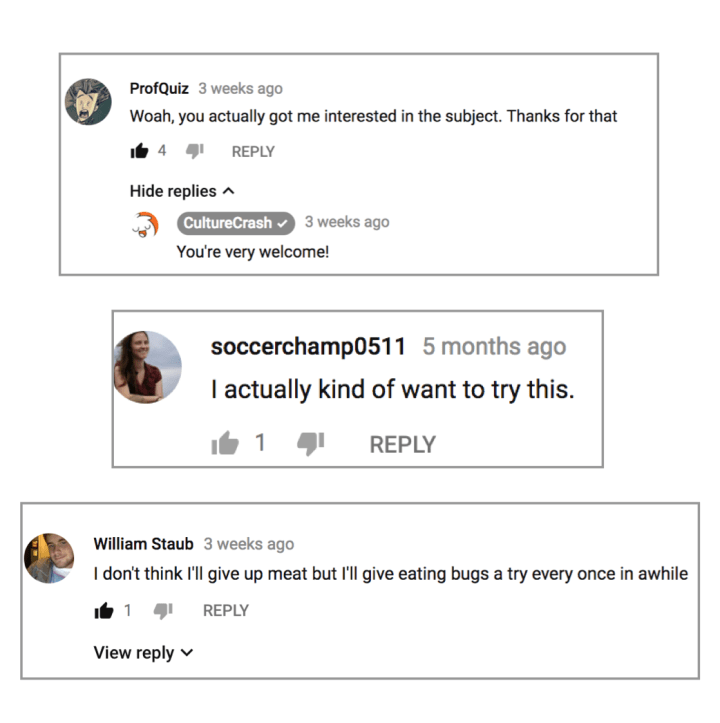
Even though Culture Crash is not a “food influencer,” per say, the channel did educate its 157,000 followers about the benefits of eating bugs. And we saw an engaged audience emerge with comments like:
eat-bugs-comments.png

How Influencers Impact Foodie Audiences

Social media has changed the way we eat, shop, travel, and dress. Whether viewers are looking for a new recipe, seeking entertainment by watching a punk metal band eat scorpions, or watching their favorite “muckbang,” food is a thriving topic on platforms like YouTube.
The impact is palpable. According to Millward Brown Digital, food channel subscriptions grew over 280% in 2015 and social engagement on food channels rose by 118%. Most viewers tune into food videos on YouTube for four main reasons: entertainment, exploration, expertise, or relaxation/ease. Videos span the spectrum from inspiration to creation to flat out voyeurism: we watch the chefs, the teachers, and the “watch me eat 3 pizzas in under an hour” daredevils.
The foodie audiences are one of the most highly engaged online – full of people dedicated to all things delicious. These are the folks that are more than happy to devote portions of their paychecks towards food – a passion that translates to huge opportunities for brands. According to a study, 92% of consumers trust recommendations from others, even individuals they don’t know, over heavily branded content.
This is nothing new. Restaurants have long opened their doors to food critics and sites like Yelp are large factors in where we decide to dine out. While these trusted sources are sought out by customers ready to make a purchase decision, working with influencers delivers messages to broader audiences. Also, the content creators lend their creativity and thought leadership to engaging new audiences as well.
One such influencer, Rukshana Kapadia of The Culinary Commentator, explains, “Eating food is an experience. We eat with many senses and the visuals are very important. Instagram has had an enormous impact on the food industry. It’s also been a great tool to entice people to try new cuisines, to become adventurous with their taste buds, to inform people and educate them about the enormous variety of food available…”

Considering Both Macro and Micro Influencers

It’s not just the content creators that have the power of mind-control. 81% of people are influenced by their friends’ social media posts. Let’s admit it – it’s now commonplace to capture and post a beautifully edited photograph of our dinners before we dive in. Reportedly, 74% of consumers identify word-of-mouth (WOM) as a key determinant in their purchasing decision. Forbes suggests 64% of marketing executives believed WOM is still the most effective form of marketing to improve customer engagement and get the word out.
It’s important to note that audiences are highly influenced by the comment sections of the content they are consuming.
Pro tip: make sure you work with influencers that have compassionate and curious communities. It is important to note that the power of influencers does not lie in the follower count. It lies in the tone and engagement of their communities:
eat-bugs-comments-2.png

How to Communicate Through Influencers

As the wise man once said, “It’s not WHAT you say, but HOW you say it.” Audiences might not remember the details of all the content they consume, but they do remember how content makes them feel. I suggest working with influencers to focus on one of three “thematic messages” when crafting content for audiences.
Most food audiences are looking for one of three things: inspiration, education, or curation:
  1. Inspiration: Imagine a mom with a fridge full of leftovers wondering what to do with them. Or a young professional wondering how to make a healthier version of her favorite dish. The new generation turns to content creators to break away from routine, learn about a new cuisine, or find a creative way to serve appetizers at the next “Wine Wednesday.” Brands can create aspirational content to persuade audiences to try new things. 
  2. Education: YouTube and Pinterest are encyclopedias of knowledge for the aspiring chef or twenty-something searching for “How to Boil an Egg.” Brands can work with influencers to teach their audiences how to metaphorically fish – creating new habits or hobbies (aka customers) in the process. Mental Floss is a great example of how an educational community can impact the foodies out there. 
  3. Curation: The social media generation is always looking for trusted sources to help them filter through the myriad of options available to modern consumers. Audiences trust the recommendations of influencers. Find influencers who authentically love your product and provide the proper incentives for them to evangelize. 
Above, you can watch the great cast of Think Tank in a three-part educational video series about trying bugs, why some people eat bugs, and how to normalize bugs.
Consider all types of content, from small, quick videos of cooking and plating techniques to announcements of new restaurant or product launches (or Bugible dinners!)
You can even partner with non-traditional “influencers” like UCLA to create great content.

Feeding Hungry Fans the Right Messages

Don’t get me wrong – I love an Epic Meal Time episode where I can watch big dudes make a 10,000 calorie waffle breakfast with Jack Daniel’s – loaded syrup. But as a past food policy student, I’m here to sing the praises of the influencers that use their powers of persuasion to encourage positive lifestyle changes. The content creators who open up the mind of a picky eater to a new culture’s cuisine. Or the video that shows how small dietary changes can have a huge environmental impact.
Not all content has to be serious to have an impact. We reached Good Mythical Morning’s 13,000,000 followers with videos titled Bug and Wine Pairing Taste Test and Eating A Bug Burrito – Bug War Challenge #2.
Content creators are changing the food industry, and one needs to look out for creators with integrity.  Increasingly, food influencers play a key role in the widespread awareness of culinary trends. We share a deep, personal relationship with food. In the age of social media, it’s not just what we eat that is impacted by our peers, but also when, where, how, and why. Yes, this presents huge opportunities for businesses to impact food-purchasing decisions. More important, perhaps, is the opportunity to impact the dialogue that occurs around how what we eat impacts our bodies and the environment.
According to Bloomberg, $255 million is spent on influencer marketing every month. You don’t need to spend the big bucks to get your message out to the masses. You might even get lucky and land a spot on Netflix’s Bill Nye Saves the World if you persist!  
Source:  https://bugible.com/2018/06/08/how-to-promote-food-brands-with-influencers/